Friday, September 23, 2011

Wait, What?

So for the past several months I've been trying a new "organic" nutrient solution from General Hydroponics called Biothrive Grow.  It's even vegan.  I've put up with a lot from this stuff, you can't test it in any way accept for temperature(no PPM/TDS/PH), and the recommended dosage turned my reservoir in to a foamy foul smelling mess that, at one point,  I had to nuke with peroxide.  Seeking a solution to these problems I found this post on the General Hydroponics blog.

So the foaming is most likely caused by the small bubbles made by both my water pump and by the air stone in the reservoir.  A General Hydroponics employee posted a suggestion that a General Hydroponics Product called Bio-Marine, which is essentially fish oil, would help.  Which is supposed to work in the same way that adding a drop of oil will stop a pot of ramen from over-boiling.   This helpful tip, however is refuted, in another unrelated post, by another GH representative stating that Bio-Marine will "funk up" a recirculating system. Sigh.

Later on in the original post, appears this helpful quote:


"While lots of growers are experimenting, at this point, GH is not intending BioThrive to be a base for hydroponics."

Thanks for nothing General Hydroponics

I shall press on.

Wednesday, September 21, 2011

The Hardware

Here is my current system configuration:

4 Tier adjustable metal shelf from K-mart
American Hydroponics Baby Bloomer w/ Hydroton
180 watt Blackstar LED Grow light from Lighthouse Hydro
Hydrofarm Commercial 2ft 4 tube T5 fixture
Four 4" Personal Fans Two to exhaust heat and the others circulate cool air
Vick Ultrasonic Humidifier
Hard Cider CO2 Enrichment System (the subject of an upcoming post)
all happily wrapped in Mylar

Three plug-in timers:
one for the lights (currently on an 12/12)
one for the water and (currently in a 3 hour cycle)
one for the humidity and air circulation (currently in a 30/15).

This setup is going strong so far. The only downside is that the UFO, which I keep abount in the middle of the box, blows its exhaust air in all directions around it resulting in heated air blowing unto some of the leaves. 

My future upgrade plans are to automate the fans and humidifier with a thermostat and humidistat for greater precision.  Also, I'd like to upgrade to a 54w T5 Fixture.


Wednesday, September 14, 2011

Perpetual peat pot problems

Note to self: Peat pots are problems o' plenty.  Once wet, the pots hold too much moisture and drown the seeds. After that, they dry out too quickly, sucking the water and life from the seed and roots.  Of the 10 I've used thus far, only 3 or 4 seeds have sprouted. One of them being basil, the world's easiest plant to grow.  The rest have either remained lifeless or grown a layer of green mold, marking what should have been a place of new life into a tombstone  . 

Monday, September 12, 2011

Wonder and Warnings

09/11/2011
The good, the bad, the longan


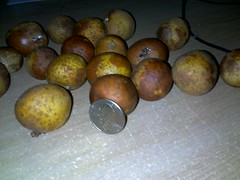
I was walking through the store today and came across a bunch of longan that were the largest that I've ever seen. Pictured above, with a quarter for scale, is a few from that bunch. There were about the size of a large grapes. However, should you come across such longan, leave them where you found them because the taste was horrible. The increase in size came at the cost of flavor.  Longan isn't the best, but watered-down longan is hopeless.  Another reason why you're not reading Longanyum.

Wednesday, September 07, 2011

Yearly Reading


After finding a really nice copy of The Lychee and Lungan by George Weidman Groff on the Internet Archive. I feel like I've just read it for the first time. Most copies of this text consist of scanned pages that are then converted into a black and white image, while this version is a color scan of the book and I think that made for a much easier, or rather more natural reading.

Sunday, May 24, 2009

How did the Tempura Lychee turn out?

THE PLAN


THE RESULT


I think I was pretty close. They didn't taste too bad either. The next time I try this, I'll only bread them once, the taste of the overpowered the Litchi slightly. However this might have been because they were canned lychee. I also think that it would be better to dry the fruit as much as possible before frying. Also, deep fryer would have made life a lot easier.

Wednesday, April 22, 2009

System 2.0

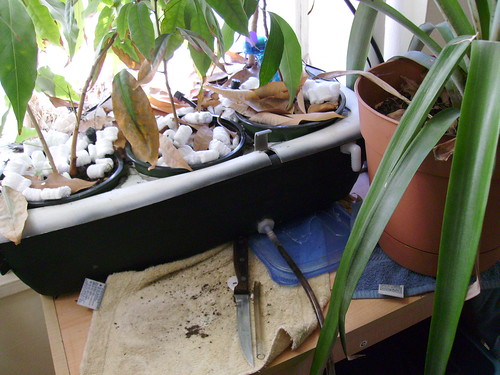
I'm predicting that the lychee will out grow their window this year. Three of them have already begun to send leaves past the top of the light which can't be moved much higher. The solution I've chosen is to build a new system and use both of my windows instead of just one. Here are a few pictures of my current set up before I change it.


In this picture here you can see I've taken a tupperware container and cut holes in the lid to place the pots. The bottom of the container is painted black to block as much light from the rootzone as possible. The top has been painted white to reflect as much light as possible back to the trees as possible. You can also see the tube that is used for both drain and fill. (the plant on the right of the photo my pineapple plant Amy which I grew from fruit purchased from Sam's club)


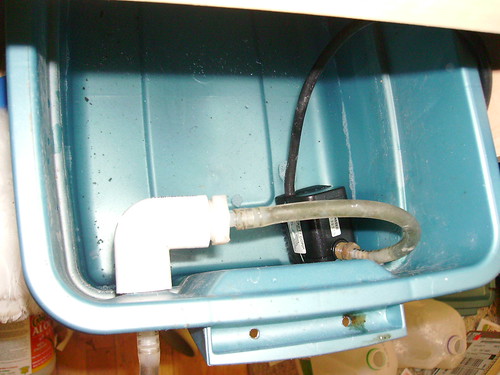
Here you can see the reservoir and the water pump. The water both drains and fills through the pump itself. In the bottom left portion of the photo you can see drain tune which connects to the container housing the trees.


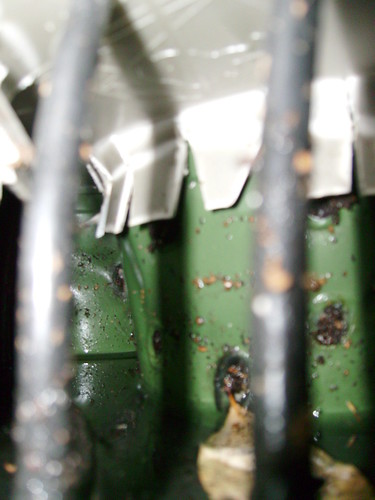
Here is a photo under the lid. If you look closely you can see the bottom of the pots are partially submerged.


Not shown in any of these photos is the light which is a 125W hydrofarm CFL and the timer which is controls the light and pump.

What I liked: This system has held up pretty well for a while now. It was much easier than watering individuals plants. The timer


What I didn't like: water only submerged lower 20% of pots, the plants closer to the window grew much faster than the one on the farther side, forcing me to raise the light, making the problem worse. The pots are made of a soft thin plastic which prevents me from easily removing the trees for cleaning/foliar feeding.

Monday, February 02, 2009

It appears that there are 42 different varieties of Lychee

Take a look here. It appears to be a website of another Chinese lychee amusement park. This one however seem more dedicate to the history of the fruit rather than the growing of it.

Sunday, September 28, 2008

The O'Berry Lychee and Yoga Farm


View Larger Map


Yes, and yoga. Picking season for lychee and longhans from the last week in May until the fruits are gone (usually in July)

Monday, August 25, 2008

My next Grow light

Here is where my next $600.00 dollars are going.


There it is. The Procylon-100 LED Grow Light
Features:

• 56 CREE* Xlamp high power LEDs (40 Red, 16 Blue)
• 100W nominal LED power delivery
• 125W total power consumption
• Integrated power supply; requires no “ballast”
• Replaces 400W HID light, giving 75% power savings
• Covers approximately 10 square feet
• 50,000+ hour LED life**
• Proudly Made in the USA!

Monday, January 14, 2008

Make Your Own: Supernatural's Green Stay

SuperNatural Green Stay The importance of keeping the leaves healthy and green through out their growing cycle can make a dramatic difference in flower and vegetable production. It is easy to keep your plants healthy and green. By using a foliar spray of professional quality nitrogen, magnesium, and iron formula like Supernatural Brand Green Stay, results can be seen in just two days with one application. Combine with Ultimate B1 Thrive for the highest quality first aid for plants.

Mix:
6 grams of potassium nitrate
2 grams of Epsom salts
5 ml of Seachem iron (or other soluble chelated iron use Seachem as it's easy to find)
1 gallon of water

Foliar feed once midway through the flowering cycle, and once 2 weeks before harvesting. This should allow the plant to more effectively photosynthesize by keeping chlorophyll alive and well, which should in turn increase the mass and density of the flowers.

The spray schedule is not for lychee but its a start. This product is listed as a first aid and not a regular fertilizer.

Make your own: Canna PK 13/14


Canna PK 13/14

Fast growing plants may need additional Phosphate (P) and Potassium (K). CANNA PK 13/14 stimulates floral development during the blooming phase, providing exuberant flowers and larger yields. Depending on the EC values and the type of growing medium used, this additive contributes to improved bloom and fructification. The form of the nutrients used requires a very small amount of absorption energy. This allows the plant to fully focus on blooming.

NPK Formula: 0-13-14

Lychee are certainly not fast growing. But I still think I'll give this a try.

Two ways to go about this one. First would be draining your reservoir, mixing up a nutrient solution with a NPK ratio of about 2-15-15. Let the plants use this solution for 24 hours, then dump and revert to your original mixture. This is what I would do, but I have lab equipment at hand and can easily determine the correct mixture. For the average gardener, I would mix:

16 grams Epsom salts
10 grams of monopotassium phosphate
5 grams potassium sulfate
1 gallon of hot distilled or reverse osmosis water

Let the mixture sit and cool, and if no cloudiness is present, foliar feed the under-side of the plants leaves. I would not recommend doing this more than once or twice during the plants flowering cycle, as potassium is deadly in very high concentrations.

A recipe for a one part 100% water soluble nutrient mix, using easy to obtain chemicals

Here are a few mixes I found they're not for lychee but I'll be using them as a starting point.

Vegetative mix:
1 US gallon R/O water
Calcium Nitrate - 2.2 grams *
Potassium Nitrate - 0.5 grams
Epsom Salts - 1.2 grams
Monopotassium Phosphate - 0.9 grams
Potassium Sulfate - 1.5 grams
Plantex CSM +B - .3 grams
* 3/4 cup of fresh sterile urine may be substituted

Blooming mix:
1 US Gallon R/O water
Calcium Nitrate - 3.1 grams *
Epsom Salts - 1.7 grams
Monopotassium Phosphate - 1.1 grams
Potassium Sulfate - 2.7 grams
Plantex CSM+B - .3 grams
* 1 cup of fresh sterile urine may be substituted.

How to mix if you aren't using zero or close to zero tds water -
1. Fill 1 gallon container half full.
2. Pre mix all ingredients in a small amount of hot water.
3. Add potassium nitrate and potassium sulfate to the container.
4. Fill container 3/4 full.
5. Add Epsom salts and monopotassium phosphate.
6. Stir well while adding calcium nitrate.
7. Add the Plantex-CSM+B
8. Top off container and pH to 5.8-6.4
9. Add .5 ml Seachem Iron if needed after mixing and pH'ing.
Failure to mix in the proper steps will cause calcium to precipitate out of solution and become unavailable to the plants. Water as close to zero tds as possible is highly recommended.

OR in a A-B parts form

For a 3 part concentrated mix (he did give that info, but I condensed the mixing directions and left it out):

Veg
Part A
1 US gallon R/O water
22 grams Calcium Nitrate *
* - You may not be able to keep 22 grams of calcium nitrate in suspension (depending on water purity). If this is the case, use 11 grams and double the dosage.

Part B
1 US gallon R/O water
Epsom Salts - 17 grams
Monopotassium Phosphate - 11 grams
Potassium Sulfate - 27 grams

Part C (micro)
1 gallon tap (chlorinated) water
30 grams Plantex-CSM+B

Dosage - 12 ounces of each part per gallon of reservoir volume.


Bloom
Part A
1 gallon R/O water
31 grams calcium nitrate *
*-You may not be able to keep 31 grams of calcium nitrate in suspension (depending on water purity). If this is the case, use 15.5 grams and double the dosage.

Part B
1 gallon R/O water
Epsom Salts - 17 grams
Monopotassium Phosphate - 11 grams
Potassium Sulfate - 27 grams

Part C (micro)
1 gallon tap (chlorinated) water
30 grams Plantex-CSM+B


Dosage - 12 ounces of each part per gallon of reservoir volume. These are just simple ratios. If you can double the amount of ingredients per gallon of water, use half as much per dose.
It can also be scaled down, i.e.- 1 quart water and 1/4 the amount of dry fertilizers will still equal a 12 ounce per gallon dose. 1 quart water and 1/2 the listed amount of dry ferts will equal a 6 ounce per gallon dose.

Mixing notes:
Part A
Add calcium nitrate slowly to water while stirring. Often it will help to heat the water. After mixing let the solution settle for 24 hours. If there is any cloudiness or precipitate, cut the solution by 50% with fresh water.

Part B
1. Fill 1 gallon container half full.
2. Pre mix all ingredients in a small amount of hot water.
3. Add potassium nitrate and/or potassium sulfate to the container.
4. Fill container 3/4 full.
5. Add Epsom salts and monopotassium phosphate.
6. Top off to 1 gallon.

Part C
Fill container with 3/4 gallon chlorinated water.
Add Plantex-CSM+B
Mix well
Top off to 1 gallon, again using tap (chlorinated) water.
Store in an opaque bottle, or in a dark place.
If chlorinated water is not used, this must be stored in the refrigerator.

Thanks go out to a nameless University professor from California

Sunday, January 06, 2008

Could coco coir cause harm?


After discovering this article about the possible negative affect of using coco coir. Although I like working with coir, my plants tend to resembles the results of this study. So, I'll be switching to a soil that is about 1/3 Schultz Cactus potting mix and 2/3 peat moss.

PDF from the Utah State University crop physiology laboratory located here.

Friday, December 28, 2007

Lychee Trip 1- Getting a Passport into China


Step One: Locate and go to your local "Passport Acceptance Center"

Step Two: Fill out the appropriate form - In my case it's the DS-11

Step 3: Present the completed form with your 2 pictures. Don't forget the $97 Here for Details


Once you have the passport, you'll next need a visa


Looks like I'll need the Single-Entry L Visa and another 100 bucks.


An important point to remember:

Visa Validity and Duration of Stay

Usually the validity of a Single Entry or Double Entry "L" visa is 90 days or 180 days from the date of issue. This means the holder of the visa shall enter China no later than 90 days or 180 days from the date of issue, otherwise the visa is expired and is null and void. The duration of stay of a "L" visa is 30 days, which means the holder of the visa may stay in China for up to 30 days from the date of entry.The visa officer may extend the Duration of Stay if the applicant needs and requests a stay in China for more than 30 days.

So timing is important as well.


Total cost: Passport $ 97.00
Visa $ 100.00 = 197.00

plus passport photos 7.99 from Rite Aid/Walgreens or Free (maybe)

Tuesday, December 18, 2007

Lichi Trip - Plane Ticket

A mere 1,277 dollars, that's how much a flight to Shenzhen airport from the east cost of America. I've chosen to visit on the last two weeks in May. Whether this is the best time to go, I don't know yet. But the price shouldn't change too much. This ticket is form Asiana Airlines.

Monday, December 10, 2007

Trip 1 - Cont.

So we're on our way to Lichi world, what all are we going to need?

Ingredients:
Passport
5 day hotel stay
Plane Ticket
Meals
Transportation once there
appetite for lychee

Really that's all it takes. Let's see how things work out.